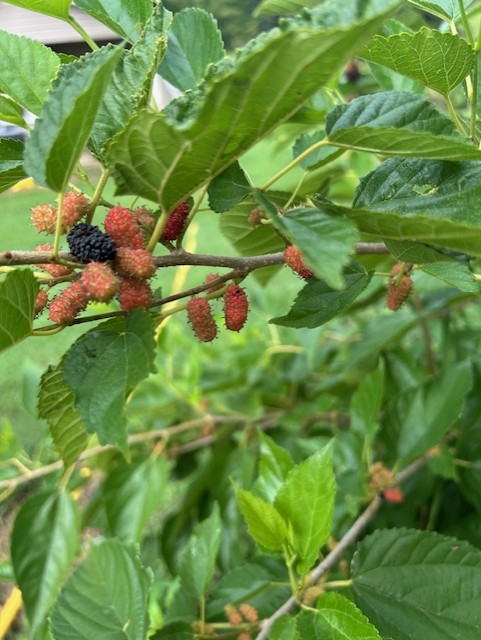
I really like growing dwarf mulberry trees, although I would consider them a bush more than the a tree. I have several around my hobby farm. The variety that I have is Jans best. I get lots of berries and they even seem to grow better in pots than the ones planted in the ground. So If you’re looking for a beautiful fruit tree that’s easy to grow and delivers sweet, abundant berries, a dwarf mulberry is definitely worth it—especially if you’re okay with some upkeep for the rewards. Just be mindful of placement, pruning, and cleanup. With the right care, it can be a delightful, productive part of your garden for years to come.
Pros
- Compact and Productive:
Dwarf label mulberries typically reach about 8–15 feet tall and wide—much smaller than standard mulberries. Pruning helps maintain size or restrain them to even smaller, container-friendly heights (around 4–6 ft) - Early and Abundant Fruit:
Many produce fruit within 1–3 years, sometimes even in the first year. The berries are veryflavorful—great fresh eating, in jams, baking, or smoothies - Self-Pollinating & Low-Maintenance:
One tree is sufficient for fruit production, and they require minimal care once established—adaptable soil preferences and moderate watering needs - Wildlife-Friendly & Culinary Gold:
Attract birds and beneficial insects, and the berries are filled with antioxidants and vitamins, ideal for culinary creations. - Great for Containers or Small Yards:
Can thrive in large pots or small landscapes with regular pruning.
Cons
- Still Pretty Vigorous:
Even dwarf varieties grow faster and larger than expected—10–15 feet if planted in-ground - Aggressive Roots:
Mulberry roots are shallow and sprawling, which can disrupt foundations, paths, or underground utilities if planted too close—root barriers and spacing are important - Messy Fruit:
Fallen berries can stain surfaces and create a slip hazard. You’ll need to be mindful about where you plant them—away from patios or walkways—or be ready to harvest promptly or use drop sheets - Invasiveness Learning Curve:
Some mulberries, especially white mulberries, are considered invasive and can spread via root sprouts or bird-dropped seeds. Choosing sterile or non-invasive varieties can help mitigate this risk - Pruning Commitment:
Avoid overgrowth and maintain accessibility by pruning yearly. If in a container, you’ll need to repot every few years due to vigorous root growth
Should I grow a mulberry tree?
| Benefit | Drawback | Verdict |
|---|---|---|
| Compact size, great for small spaces | Can exceed desired size without pruning | Very promising with regular maintenance |
| Early, flavorful fruit | Potential for fruit mess and stains | Manageable with placement and cleanup |
| Self-pollinating, low-care | Aggressive roots and possible invasiveness | Plant with root barrier, prune often |
Tips If You Decide to Grow One
- Place Smartly – Keep at least 8–10 ft from structures or install root barriers
- Prune in Dormancy – Prune after leaf drop or winter to control size and encourage fruiting
- Choose the Right Variety – Look for dwarf everbearing or named cultivars like ‘Doug’s Dwarf Mulberry’ (~8 ft mature height
- Container Considerations – Use large, sturdy pots and be prepared to up-pot every few years
- Harvesting Strategies – Use a sheet beneath the tree to catch falling berries or pick often to minimize mess

Top Dwarf Mulberry Varieties
1. Gerardi Dwarf Mulberry
- Size & Growth: Compact, typically reaching only 6–8 feet tall—ideal for small gardens or containers.
- Fruit: Produces large, sweet-tart, juicy berries over an extended harvest period.
- Disease Resistance: Immune to “popcorn disease,” a common issue for some mulberry hybrids.
- Hardiness: USDA zones 4–9, cold-hardy and reliable.
2. Doug’s Dwarf Mulberry
- Size & Growth: A slower-growing variety discovered in Northern California; stays around 8 feet even after several years.
- Fruit: Dark black berries, noted for being sweet and flavorful.
- Characteristics: Excellent for bonsai styling or small-space gardens.
- Hardiness & Yield: Hardy to about –15 °F, begins fruiting in 2–3 years, yielding around 15–25 pounds.
3. Dwarf Everbearing Mulberry
- Size & Growth: Typically managed to 6–8 feet, though mistakenly sold taller in some cases.
- Fruit: Sweet, small-to-medium black berries produced over an extended season (spring to fall).
- Container-Friendly: Frequently used in patio gardens—especially the “compact” forms like ‘Issai’ or ‘Gerardi.’
4. Thai Dwarf Mulberry (Morus alba hybrid)
- Size & Growth: Reaches about 12–15 feet—slightly larger dwarfs, still manageable for small yards.
- Fruit: Medium-sized berries with a unique blend of blueberry and raspberry flavors—highly flavorful and abundant.
- Versatility: Well-suited for both containers and open garden beds.
5. Other Notable Mentions
- Jan’s Best Dwarf: Cold-hardy and compact, compact, productive mulberry with superior flavor. Often recommended for container growing.
- Pakistan / King White Pakistan: Produces extra-long, delicious fruits—‘King White Pakistan’ offers sweet, seedless white berries reaching up to 4″, best for warmer zones.
- Illinois Everbearing: Hardy and highly productive, though needs space or strong pruning to stay compact. Fruit is large, nearly seedless, and very sweet.
Quick Comparison Table
| Variety | Mature Size | Fruit Flavor & Yield | Best For | Notes |
|---|---|---|---|---|
| Gerardi Dwarf | ~6–8 ft | Sweet‑tart, juicy, extended season | Small gardens, containers | Compact, popcorn-disease resistant |
| Doug’s Dwarf | ~8 ft | Sweet, dark berries | Bonsai, small spaces | Slow-growing, cold-hardy, high yield |
| Dwarf Everbearing | ~6–8 ft (if contained) | Sweet, long fruiting season | Patio/containers | Manageable size with pruning; common cultivar |
| Thai Dwarf | ~12–15 ft | Blueberry‑raspberry flavored | Small yards, containers | Very productive, flavorful; slightly taller |
| Jan’s Best | Compact | Superior flavor | Cold climates, containers | Hardy cultivar, container friendly |
| Pakistan / White Pakistan | Larger | Very sweet, extra long berries | Warm climates, edible landscape | Vigorous—needs space or heavy pruning |
| Illinois Everbearing | Vigorous | Very sweet, nearly seedless | Larger spaces or pruning-controlled areas | Needs pruning to stay dwarf |
Choosing the Right Variety for You
- Tight on space or need a container-friendly tree? Choose Gerardi Dwarf, Jan’s best Doug’s Dwarf for truly compact, manageable growth.
- Want exotic flavor and abundant fruit? Thai Dwarf stands out with its unique taste and productivity.
- Live in cold climates? Gerardi Dwarf offer hardiness and reliability.
- Looking for larger, dramatic berries? Pakistan or Illinois Everbearing offer generous fruit—just be prepared to prune.
My choice was Jan’s Best
Highlights
1. Exceptional Taste & Fruit Quality
- The berries are described as sweet with a pleasant tart balance, a mix between blackberries, blueberries, and raspberries—and notably, seedless with no internal stem.
- Fruit size averages between ½ to 1 inch long.
2. Prolific & Extended Production
- This variety often produces two to three harvests per season when pruned promptly after each crop.
- It typically fruits slightly later than many common mulberries, helping extend your harvest season.
3. Easy to Root & Resilient
- Cuttings root readily, often with high success rates.
- Displays good drought tolerance, handles rain well, and seems to resist disease better than some other varieties.
4. Wide Hardiness, with Caveats
- Successfully grown from USDA zone 5A all the way to 10, including in-ground plants in zone 5A with proper care.
- Some reports indicate dormancy breaks very early (as early as January or February), making the tree vulnerable to late frosts—especially in zones 6 and colder. Protective strategies like burlap wrapping or greenhouse care may be needed.
Summary Table: Jan’s Best at a Glance
| Feature | Details |
|---|---|
| Flavor | Sweet-tart, complex berry flavor, seedless, no central stem |
| Fruit Size | Approximately ½ to 1 inch long |
| Yield | 2–3 harvests per season with proper pruning |
| Ease of Propagation | Easy to root from cuttings |
| Resilience | Drought-tolerant, rain-resilient, good disease resistance |
| Hardiness Zones | Performs from USDA zones 5A to 10 |
| Challenges | Early dormancy can expose it to frost damage in cooler climates |
| Grower Source | Developed and shared by Jan Doolin (FruitTreeAddict) |
Pruning
Pruning a dwarf mulberry tree is essential to control its shape, encourage fruiting, and keep it manageable—especially if it’s in a container. Fortunately, dwarf mulberries respond very well to pruning.
Why Prune a Dwarf Mulberry?
- ✅ Promote more fruiting wood
- ✅ Control size and shape
- ✅ Increase airflow and sunlight penetration
- ✅ Remove dead or damaged growth
- ✅ Encourage branching for bushier growth
When to Prune a Dwarf Mulberry
| Season | Purpose | Notes |
|---|---|---|
| Late winter / Early spring | Structural pruning | Best time for heavy pruning before bud break |
| After fruiting (summer) | Light shaping & regrowth | Encourages a possible second crop in everbearing types |
| Fall | Avoid major pruning | Can encourage new growth vulnerable to frost |
For everbearing dwarf mulberries like Jan’s Best or Dwarf Everbearing, light summer pruning after a crop can encourage a second fruiting flush.
How to Prune Step-by-Step
1. Clean Tools
Always start with sharp, clean pruners to avoid disease.
2. Remove Dead or Weak Branches
- Cut off any:
- Dead
- Diseased
- Damaged
- Crossing or rubbing branches
- Cut back to the branch collar (where the branch meets the trunk or limb).
3. Shape the Tree
Decide on your shape:
- Bushier form: Keep it low and encourage lateral branching.
- Tree form: Choose a central leader (main trunk) and prune lower branches.
Dwarf mulberries can be kept under 6 ft with regular shaping.
4. Tip-Prune for Branching
- Snip the tips (2–4 inches) of vertical shoots.
- This encourages side branching and bushier, compact growth.
5. Thin Out for Light and Airflow
- If the canopy is too dense, thin inner branches to prevent mold and encourage ripening.
6. Limit Size
- Cut back the top and sides to maintain a manageable height.
- Mulberries tolerate heavy pruning, so don’t be afraid to cut back ⅓ or more if needed.
Aftercare Tips
- Mulch around the base (not touching the trunk).
- Water well after pruning to reduce stress.
- Fertilize lightly if new growth is desired.
Container-Grown Dwarf Mulberries
- Prune more often to keep them in bounds.
- Consider root-pruning every 2–3 years if the plant becomes pot-bound.
- Train into a bonsai-style shrub if desired—mulberries tolerate this well.
Annual Pruning Plan
| Time | Task |
|---|---|
| Late winter | Hard prune to shape + remove damage |
| Early summer | Light prune after 1st fruit crop |
| Mid summer | Shape + encourage 2nd crop (if everbearing) |
| Late fall | Only remove obvious deadwood |
Propagation
Propagating mulberries is surprisingly easy, especially dwarf varieties like Jan’s Best, Dwarf Everbearing, and Gerardi Dwarf. The most common methods are:
- Cuttings (most popular)
- Air layering (more advanced)
- Seed (not recommended for true-to-type results)
Step-by-Step
This is the easiest and most effective way to propagate mulberries is taking cuttings.
1. Take Cuttings
- Best time: Late winter to early spring, or after summer pruning
- Use semi-hardwood or hardwood cuttings (pencil-thick is ideal)
- Cut a 6–10 inch branch with 2–4 leaf nodes
- Trim just below a node (bottom cut straight, top cut at an angle)
- Remove leaves from the lower ⅔ of the cutting
2. Apply Rooting Hormone (Optional)
- Dip the bottom 1 inch of the cutting into rooting hormone powder or gel
- Tap off excess
3. Plant the Cuttings
- Fill a container with moist potting mix
- Insert the cutting 2–3 inches deep, with at least 1 node buried
- Firm soil around the cutting
4. Create Humidity (Optional but Helpful)
- Cover with a clear plastic bag or dome
- Keep the bag from touching the cutting by using stakes or chopsticks
- Place in bright indirect light (not full sun)
5. Water & Wait
- Mist the cutting every few days to keep it moist (not soggy)
- Roots usually form in 3–6 weeks
- Check for resistance (a sign roots are growing)
6. Transplant
- Once rooted, transplant into a larger pot or directly into the ground
- Harden off for a week before planting outside
Tips
| Tip | Why It Matters |
|---|---|
| Use fresh cuttings | Older wood roots poorly |
| Keep soil moist | Dry soil = failed cuttings |
| Use sterile tools | Prevents disease and rot |
| Label varieties | If propagating more than one type |
Alternative: Air Layering
- Choose a healthy branch still attached to the tree
- Strip a 1-inch ring of bark
- Wrap the exposed area in moist sphagnum moss
- Cover with plastic wrap and secure
- Wait 4–8 weeks until roots form, then cut and pot
What Not to Do
- Don’t overwater – soggy soil = rot
- Don’t take cuttings during dormancy without bottom heat
- Don’t put in direct sun until fully rooted
Fertilizing Schedule
Fertilizing mulberries—especially dwarf varieties like Jan’s Best, Dwarf Everbearing, or Gerardi Dwarf—helps promote healthy growth and fruit production, but timing and moderation are key.
Best Times to Fertilize Mulberries
| Timing | Purpose | Type of Fertilizer |
|---|---|---|
| Early Spring (just before bud break) | Kickstart growth after dormancy | Balanced (e.g. 10-10-10 or compost) |
| Late Spring / Early Summer | Support flowering and fruiting | High in potassium (e.g. 5-10-10 or organic bloom booster) |
| After Fruiting (optional) | Encourage regrowth if you’re pruning for a second crop | Light feeding with compost or slow-release |
| Fall | Avoid fertilizing | Encourages new growth vulnerable to frost |
How Often to Fertilize
- In-ground dwarf trees: Once or twice per year (early spring and early summer)
- Container-grown trees: Every 4–6 weeks during the growing season with diluted fertilizer (they leach nutrients faster)
Recommended Fertilizers
| Type | Examples | Notes |
|---|---|---|
| Balanced (10-10-10) | Osmocote, Espoma Tree-Tone | Good all-purpose feeding in early spring |
| Low-Nitrogen | 5-10-10 or 3-8-9 blends | Ideal during flowering/fruiting |
| Organic Options | Compost, worm castings, seaweed, fish emulsion | Improves soil health and long-term fertility |
| Slow-Release Pellets | Osmocote Plus, Jobe’s spikes | Great for containers or forgetful gardeners |
Avoid Over-Fertilizing
Too much nitrogen = lush green growth but poor fruiting, and can attract pests or cause root burn.
General rule:
If the tree is growing vigorously and fruiting well, less is more.
Visual Signs of Nutrient Needs
| Symptom | Possible Issue | Fix |
|---|---|---|
| Pale leaves, poor growth | Nitrogen deficiency | Apply compost or balanced fertilizer |
| Poor fruit set | Low phosphorus or potassium | Use bloom booster or 5-10-10 |
| Yellowing between veins | Magnesium deficiency | Try Epsom salt (1 tbsp/gallon) |
Comments are closed