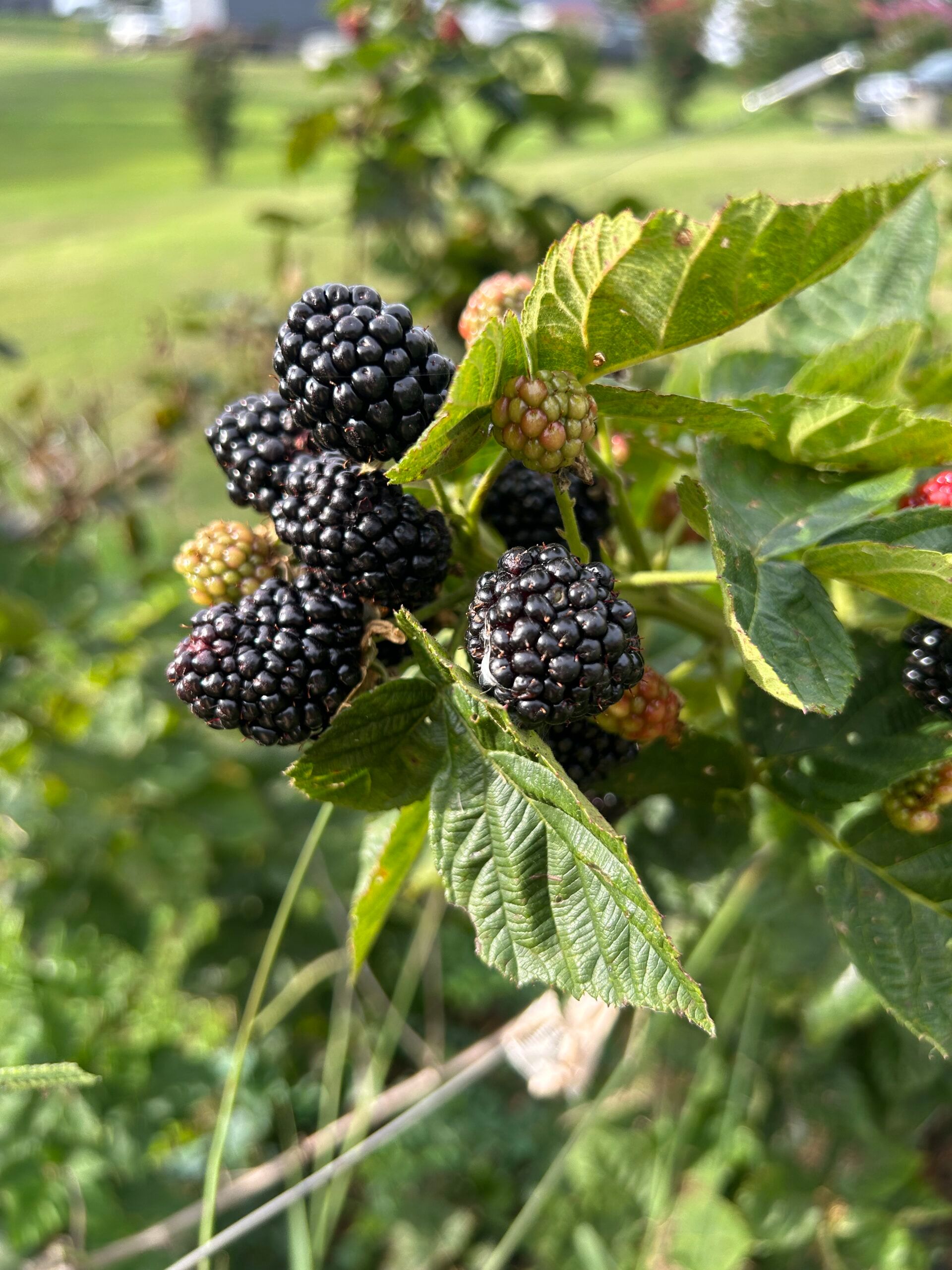
The Triple Crown blackberry is one of my favorite blackberries I grow, and I have a lot of blackberries. They are popular thornless blackberry variety known for its high yield, excellent flavor, and vigorous growth. It’s a semi-erect variety developed by the U.S. Department of Agriculture (USDA) and is widely grown by both home gardeners and commercial growers. They are a floricane blackberry so they produce berries on second year canes. The berries will form on the entire length of canes.
Key Features of Triple Crown Blackberry:
| Feature | Description |
|---|---|
| Type | Thornless, semi-erect blackberry |
| Fruit Flavor | Sweet, rich, and slightly tart – excellent for fresh eating and preserves |
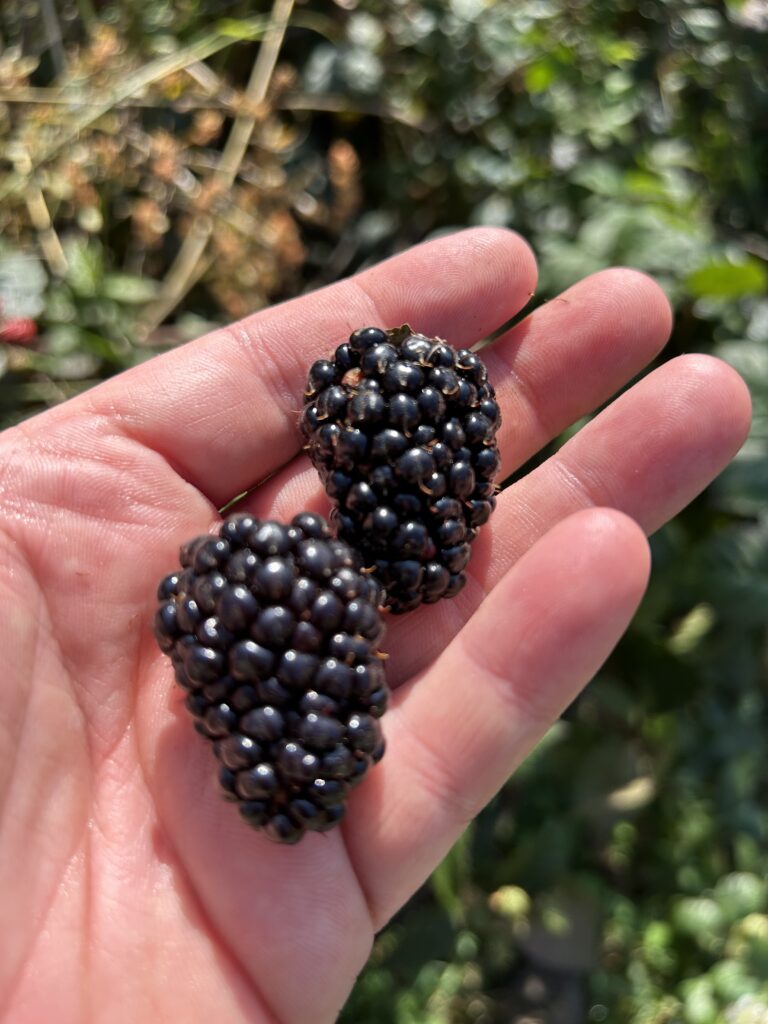
| Fruit Size | Large, glossy black berries |
| Harvest Time | Mid to late summer (usually July–August, depending on climate) |
| Growth Habit | Vigorous, semi-erect canes – benefit from trellising or support |
| Hardiness Zones | USDA Zones 5–9 |
| Yield | Very productive once established |
| Pollination | Self-pollinating (doesn’t require another variety) |
Pros:
- Thornless canes – easier to harvest and manage
- High yields
- Delicious fruit
- Relatively disease-resistant
Cons:
- Canes need support due to semi-erect growth
- Vigorous growth may require regular pruning and maintenance
Growing Tips:
- Plant in full sun with well-draining soil.
- Prune in late winter or early spring.
- Train canes on a trellis or support structure.
- Mulch to retain moisture and suppress weeds.
Overview Care Calendar
January–February
- Plants are dormant.
- Do not fertilize.
- Winter chore: check trellis stability and prune out any old, dead canes you missed after harvest.
March (Late Winter / Early Spring)
- Buds begin to swell.
- Fertilize: Apply ½ cup of 10-10-10 per plant (or equivalent organic amendment like compost + bone meal).
- Spread fertilizer 12–18″ around the crown, then water in well.
- Reapply mulch if it’s broken down over winter.
April–May
- Canes are actively growing, flowers forming.
- Keep plants well-watered.
- No fertilizer yet—plants are using March’s boost.
- Tie new canes to your trellis as they lengthen.
June (Bloom to Early Fruit Set)
- When blossoms fade and berries start forming, apply a light feeding:
- About ¼ cup of 10-10-10 per plant.
- Or a side-dressing of compost/composted manure.
- Helps support fruit development.
- Maintain 2–3 inches of mulch for moisture retention.
July (Peak Fruit Ripening)
- Harvest month!
- Do not add nitrogen now—plants need to focus on fruit, not new soft growth.
- Optional: a low-nitrogen, potassium-rich boost (like kelp meal, greensand, or wood ash in moderation) for berry sweetness.
August (Post-Harvest)
- Cut out all floricanes (the canes that just fruited).
- Thin primocanes (new canes) to the 6–8 strongest per crown.
- No fertilizer—plants are preparing to harden off for winter.
September–October
- Keep soil mulched.
- Water during dry spells, but do not fertilize.
- Optional: top-dress with compost to enrich soil for next spring.
November–December
- Plants go dormant.
- Clean up fallen leaves and debris to reduce pests/disease.
- Double-check trellis before winter storms.
Rule of Thumb:
- Main feeding = early spring (big boost).
- Secondary feeding = just after bloom (smaller boost).
- Avoid nitrogen after early July.
Planting Guide
1. Timing
- Best time to plant:
- Early spring (after the danger of frost)
- Late fall (in mild winter climates)
2. Site Selection
- Sunlight: Full sun (at least 6–8 hours daily)
- Soil:
- Well-draining
- Slightly acidic (pH 5.5–6.5)
- Rich in organic matter
3. Spacing
- Between plants: 3–5 feet apart
- Between rows (if planting multiples): 6–8 feet
- You’ll need trellising or support because Triple Crown is semi-erect.
4. Planting Steps
- Dig a hole about twice as wide and deep as the root ball.
- Amend soil with compost or well-rotted manure.
- Set the plant at the same depth it was in the nursery pot.
- Backfill and water thoroughly.
- Mulch 2–4 inches deep around the base (keep it off the crown) to retain moisture and suppress weeds.
Pruning Guide
Proper pruning is key for fruit production, airflow, and disease prevention.
Triple Crown Blackberry Growth Habit:
- Produces fruit on second-year canes (floricanes)
- First-year canes (primocanes) grow vegetatively
- After fruiting, floricanes die and must be removed
Pruning Timeline
Year-Round Tasks
- Keep canes tied to a trellis or fence to improve airflow and make harvesting easier.
Late Winter/Early Spring (Before Bud Break)
What to do:
- Remove:
- All dead, damaged, or diseased canes
- All old canes that fruited last year (floricanes)
- Thin:
- Leave 4–6 of the healthiest canes per plant
- Tip the remaining primocanes:
- Cut the tips back to 4–5 feet tall to encourage lateral branching (more fruiting sites)
- Shorten lateral branches:
- Prune laterals to about 12–18 inches
Summer (After Harvest)
What to do:
- Immediately remove spent floricanes (the canes that fruited)
- Tie new primocanes to the trellis as they grow
When to Fertilize
- Early Spring (bud break / leaf emergence)
- As soon as new green growth begins, apply the first round of fertilizer.
- This fuels strong cane growth and root activity.
- After Bloom (early fruit set)
- A second, lighter application helps the plant support berry development.
- Optional: Mid-Summer (if plants look weak or soil is sandy)
- If leaves pale or growth slows, a supplemental feeding is okay.
- Stop nitrogen applications by early July (in most regions) so plants harden off before winter.
What Fertilizer to Use
- Balanced fertilizer:
- 10-10-10 (N-P-K) or 20-20-20 works well for general feeding.
- Apply about 5–6 ounces per plant (roughly ½ cup of 10-10-10).
- Organic options:
- Compost + well-rotted manure (applied in early spring as a top-dressing).
- Blood meal or fish emulsion (for nitrogen).
- Bone meal (for phosphorus, root and flower support).
- Kelp meal (for potassium, helps with fruit quality).
- Avoid too much nitrogen:
- Too much will cause long, leafy canes with fewer berries.
How to Apply
- Broadcast evenly around the base of the plant, about 12–18 inches from the crown (avoid dumping fertilizer directly at the crown).
- Lightly scratch into the soil surface or cover with mulch.
- Water in well to move nutrients into the root zone.
Quick Tips
- Keep soil pH between 5.5–6.5 (slightly acidic) for best uptake.
- Mulch (straw, wood chips, pine bark) helps retain moisture and moderates soil nutrients.
- Fertilizer needs vary with soil type—sandy soils may need more frequent, lighter feedings than loamy soils.
Trellis/Support
| Trellis Type | Description |
|---|---|
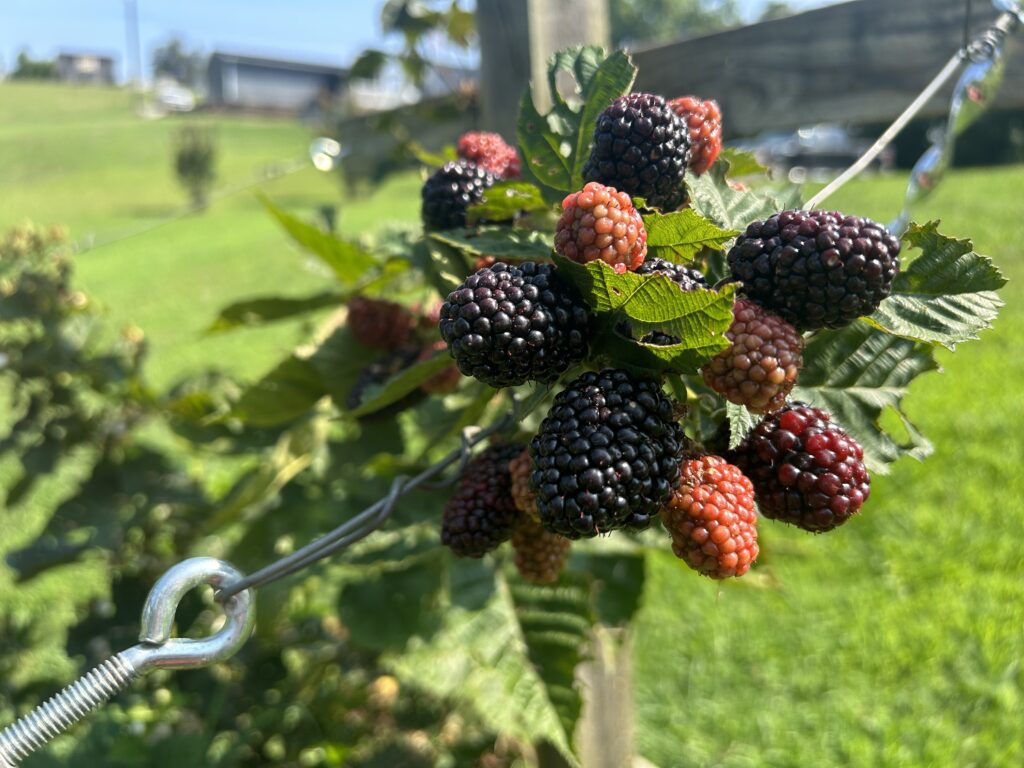
| T-posts with wire | 2–3 horizontal wires strung between T-posts, spaced about 2–3 ft apart vertically |
| Fence | A garden fence can double as a support |
| Arbor or espalier | For a decorative look in home gardens |
1. T-Trellis
- Posts about 6–8 ft apart with cross arms at the top (like a “T”).
- Wires run horizontally, typically 2–3 on each side.
- Canes are tied to wires to keep them upright and separated.
   |----|
   |    |
---|    |---
   |    |
   |    |
2. Two-Wire Trellis
- Simplest option.
- Just two parallel wires stretched between sturdy posts.
- Tie canes to wires as they grow.
Post      Wire      Post
 |--------------------|
 |--------------------|
3. V-Trellis
- Two posts at an angle form a “V” shape.
- Canes spread outward for better light and air circulation.
- Easier picking and pruning.
  \      /
   \    /
    \  /
     \/
4. Fan Trellis (Garden Style)
- Works well for smaller plantings.
- Canes are tied out in a fan shape against a flat structure or fence.
   \ | /
    \|/
     |
Pest control
Blackberries are tough plants, but they can suffer from a few insect pests and diseases that reduce yield and fruit quality. However overall blackberries require very little pest control measures or disease prevention, especially with proper pruning. I may spray my berries once a year if the Japanese beetles overwhelm them.
Common Insect Pests
- Japanese Beetles
- Feed on leaves, leaving them skeletonized.
- Control: Hand-pick into soapy water, use floating row covers, or apply neem oil/pyrethrin sprays in severe cases.
- Aphids
- Cluster on new shoots, sucking sap and spreading viruses.
- Control: Spray with insecticidal soap, neem oil, or encourage ladybugs.
- Spider Mites
- Thrive in hot, dry weather; cause stippling and webbing.
- Control: Hose plants with water to knock them off, apply horticultural oil, maintain humidity.
- Raspberry Crown Borer (can also attack blackberries)
- Larvae bore into canes near the crown, weakening plants.
- Control: Remove and destroy infested canes; beneficial nematodes in soil can help.
- Spotted Wing Drosophila (SWD)
- Tiny fruit flies that lay eggs in ripening berries, causing soft, leaky fruit.
- Control: Harvest promptly, refrigerate fruit immediately, use fine mesh netting, or organic sprays like spinosad.
Disease & Cultural “Pests” to Watch
- Anthracnose / Cane Blight – causes dark lesions on canes.
- Control: Prune out infected canes, improve airflow, and avoid overhead watering.
- Orange Rust (fungus) – bright orange spores on leaves, weakens plants.
- Control: Dig up and destroy infected plants (no cure once established).
- Botrytis (Gray Mold) – affects fruit in wet weather.
- Control: Good spacing, pruning, and picking fruit promptly.
General Pest Management Tips
- Prune correctly: Remove spent floricanes after harvest to reduce overwintering pests.
- Keep rows clean: Mulch to reduce weeds (which harbor pests), and remove fallen fruit.
- Encourage beneficial insects: Plant pollinator-friendly flowers nearby.
- Rotate sprays if needed: Use organic options first (neem, insecticidal soap, spinosad).
Organic
- Neem Oil
- Works on aphids, mites, Japanese beetles, and fungal issues.
- Best used as a preventative or at first sign of pests.
- Insecticidal Soap
- Good for aphids and mites.
- Must contact the insect directly, safe on fruit when used properly.
- Horticultural Oil
- Smothers overwintering pests like mites and scale.
- Apply during dormant or early growth stages.
- Spinosad (organic-approved)
- Effective against spotted wing drosophila (SWD) and other fruit borers.
- Must be reapplied regularly when fruit is ripening.
- Bacillus thuringiensis (Bt)
- A biological control for caterpillars.
- Harmless to pollinators when sprayed in evenings.
Conventional
- Pyrethroids (like permethrin, cyfluthrin, bifenthrin)
- Broad-spectrum, quick knockdown.
- Effective for Japanese beetles, stink bugs, and cane borers.
- Caution: Also kills pollinators and beneficial insects.
- Carbaryl (Sevin)
- Very effective on beetles but highly disruptive to bees/beneficials.
- Usually not recommended unless infestations are severe.
My take
I chose Triple Crown blackberries because they’re one of the best all-around varieties for home gardens and small orchards. I fertilize via the above schedule and have many berries. The berries are large, sweet, and flavorful berries that ripen in mid-to-late summer, extending the harvest season. The plants are thornless, making picking easier and safer, and they’re highly productive, with each mature plant yielding abundant crops year after year. I use T-trellis mainly because I find them easy to make and maintain. Triple Crowns are also disease-resistant and adaptable, performing well in a variety of soils and climates. With their balance of taste, yield, and ease of care, they’re often considered the “gold standard” of thornless blackberries.
Comments are closed