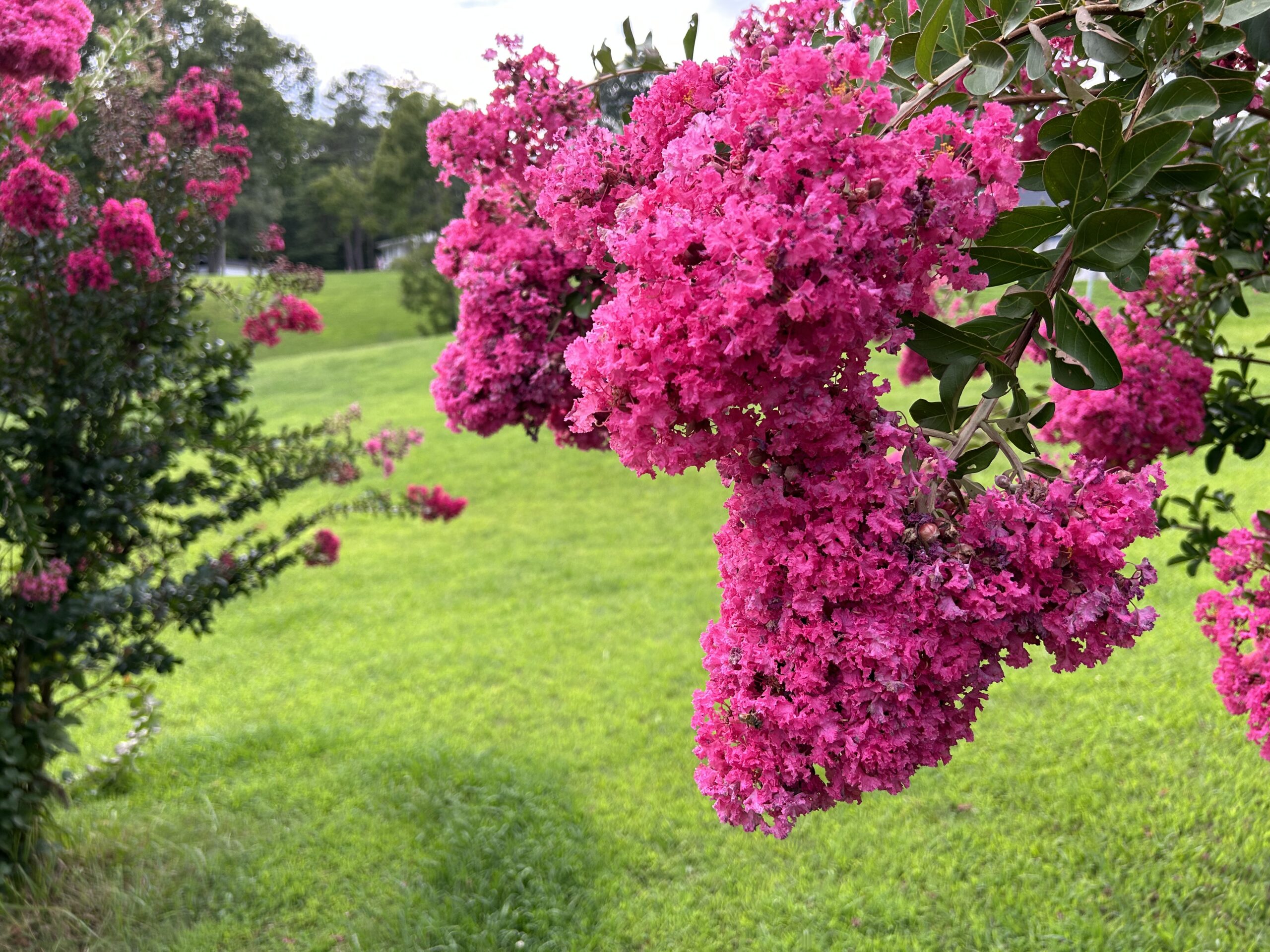
Crepe myrtles are popular plants thanks to their long blooming season, stunning appearance, and low maintenance needs. They produce vibrant clusters of flowers—ranging in color from white and pink to red and purple—that can last from late spring through early fall. Beyond their blooms, crepe myrtles also offer year-round smooth, peeling bark and a sculptural branching habit that’s especially pretty in winter. In autumn, their foliage turns vivid shades of orange, red, or yellow, adding seasonal beauty. These plants are very adaptable, thriving in full sun and tolerating heat and drought once established. They come in a wide range of sizes—from compact shrubs to tall trees—making them versatile for different landscape needs, whether used as street trees, privacy screens, or decorative focal points. Crepe myrtles are also relatively pest- and disease-resistant, especially newer hybrid varieties. While they respond well to pruning, harsh practices like “crepe murder” (severely topping the tree) should be avoided to maintain their natural form and health. All these qualities make crepe myrtles a favorite in warm climates and urban landscapes.
Main Types
By Size
1. Dwarf Varieties (2–5 feet tall)
- Great for containers, borders, or small gardens
- Often grown as shrubs
- Examples:
- ‘Chickasaw’ – light lavender flowers
- ‘Pocomoke’ – deep pink flowers
- ‘Petite’ series – various colors (like ‘Petite Red’, ‘Petite Plum’)
2. Semi-Dwarf / Medium Varieties (6–15 feet tall)
- Perfect for hedges, foundation plantings, or small trees
- Can be grown as multi-stemmed shrubs or small trees
- Examples:
- ‘Tonto’ – red flowers, mildew-resistant
- ‘Zuni’ – lavender-purple flowers
- ‘Hopi’ – light pink blooms
3. Standard / Tree-Form Varieties (15–30+ feet tall)
- Used as specimen trees, street trees, or shade trees
- Often grown with a single trunk or multi-trunk structure
- Examples:
- ‘Natchez’ – white flowers, beautiful cinnamon-colored bark
- ‘Tuscarora’ – coral-pink flowers
- ‘Muskogee’ – light lavender flowers, fast-growing
- ‘Dynamite’ – bright red flowers
By Flower Color
Crepe myrtles bloom in a wide spectrum:
- White – e.g., ‘Natchez’
- Pink – e.g., ‘Hopi’, ‘Sioux’
- Red – e.g., ‘Dynamite’, ‘Tonto’
- Lavender/Purple – e.g., ‘Catawba’, ‘Zuni’
- Coral/Peach – e.g., ‘Tuscarora’
Zone Guide for Crepe Myrtle Growth
| USDA Zone | Grow Crepe Myrtle? | Notes |
|---|---|---|
| Zone 10 | Excellent | Tropical/subtropical; thrives with long bloom time. |
| Zone 9 | Excellent | Ideal conditions; large variety of sizes/colors. |
| Zone 8 | Very Good | Grows well; flowers abundantly. |
| Zone 7 | Good | Cold-hardy varieties needed; mulch in winter. |
| Zone 6 | Marginal | Only cold-hardy types will survive (e.g., ‘Tonto’, ‘Sioux’); dieback may occur in harsh winters. |
| Zone 5 and below | Not recommended | Too cold; roots may die even with protection. |
Cold-Hardy Crepe Myrtle Varieties (for Zones 6–7)
If you’re in a cooler zone (like Kentucky), look for these cold-hardy types:
- Tonto (deep red, ~10 ft)
- Sioux (pink, ~15–20 ft)
- Zuni (lavender, ~10 ft)
- Acoma (white, ~10–15 ft, weeping form)
- Hopi (pink, ~10 ft)
Tips for Growing in Cooler Zones (6–7):
- Plant in full sun (6+ hours/day)
- Choose south-facing, sheltered spots (e.g., near a wall for warmth)
- Mulch in late fall to protect roots
- Expect top growth dieback in harsh winters, but it regrows from roots
Pruning Tips
When to Prune
- Late Winter to Early Spring (Feb–early March in most regions): Prune while the plant is dormant and before new growth begins.
- Avoid pruning in late summer or fall—it may stimulate new growth that can be damaged by frost.
What to Prune
1. Remove Suckers
- Cut off shoots at the base of the tree or from the roots. These drain energy from the main trunk(s).
2. Remove Crossed or Rubbing Branches
- Cut out branches that cross each other or rub—this prevents wounds and disease.
3. Thin Out Interior Growth
- Open up the center of the plant to improve air circulation and light penetration.
4. Shape Lightly
- Follow the plant’s natural form. Avoid cutting to random stubs.
5. Trim Spent Flower Clusters
- After blooming, remove old flower heads (deadheading) to encourage reblooming (optional).
What Not to Do
Don’t “Top” the Tree (aka Crepe Murder)
- Never cut large limbs back to stubs—this ruins the tree’s shape and causes weak, spindly growth.
Ideal Structure to Aim For
- Multi-trunk trees with open, vase-like structure.
- No suckers or low branches below about 4–6 feet (for mature trees).
- Well-spaced main branches, not cluttered or too dense.
Step‑by‑Step Pruning Use
- Start with the “skeleton”
- From the base, choose 3‑5 strong trunks (if multi‑stem) or one main trunk (if you want a single‑stem look).
- Remove weaker stems, suckers, and any that detract from form.
- Remove low branches (“limbing up”)
- Remove branches that are too close to the ground (often up to 4–6 ft, depending on tree size) to create a clean trunk appearance.
- In diagrams, you’ll see the lower third cleared of small growth.
- Thin the interior
- Cut out crossed, rubbing, inward‑growing, or weak branches to open up to light and air.
- The diagrams show the interior cleared—branches extend outward, not congested inside.
- Trim back tips (within reason)
- On branches, you can shorten tips, especially if they are overly long and angled inward.
- Make cuts just above an outward‑facing bud or branch.
- In diagrams, you’ll see cuts made where the branch begins to curve or meets another branch.
- Shape the canopy
- Your goal is a natural, vase‑shaped form (open center, nicely spaced branches).
- Avoid “hat‑rack” style (where many large limbs are cut to the same height)—that’s what leads to ugly stubs in future years (shown as “bad pruning” in diagrams).
- The differences between correct vs incorrect pruning (in the bottom-right image) show how stubs and “knuckles” form when overcut.
- Remove spent flower clusters (optional but helpful)
- If you remove old blooms mid‑season, you may encourage a light rebloom.
- When doing this, cut ¼” above an outward bud or a branch.
- In the first diagrams, you’ll see old seed pods or clusters being cut off near tips.
- Avoid large stub cuts
- Diagrams emphasize cuts flush to a branch collar or just above lateral branches—not leaving long stubs.
- That preserves bark healing and avoids ugly growth.
Tips from the Visuals & Best Practice Notes
- Aim for balanced removal, not drastic topping. Removing too much at once risks weak whip growth.
- Focus on branch junctions: cut just above where a branch meets a stronger branch (but not below).
- In the diagrams, the tree is pruned while dormant—so structure is easy to see.
- After pruning, branches that remain are those that contribute to shape and have space.
Crepe Myrtle Fertilization Guide
| Factor | Details |
|---|---|
| Best Time to Fertilize | – Early Spring (March–April) – Optional: After first bloom (June–July) |
| Fertilizer Type | – Balanced: 10-10-10, 8-8-8 – Bloom booster: 5-10-10 |
| Avoid | – High nitrogen (e.g., 20-5-10) → causes leafy growth, fewer flowers |
| How Much to Apply | – ½ to 1 cup of granular per plant (based on size) |
| Where to Apply | – Spread evenly around drip line, not at trunk |
| Application Method | – Granular: Scratch into topsoil & water well – Liquid: Apply monthly if needed |
| Soil Notes | – Clay soil: Go lighter, nutrients last longer – Sandy soil: May need more frequent feeding |
| Containers | – Use slow-release pellets or monthly liquid fertilizer |
| When to Stop | – Mid-August (don’t fertilize past this date) |
| Common Mistakes | – Fertilizing too late – Using lawn fertilizer – Over-fertilizing |
Notable Crepe Myrtle Varieties
| Name | Flower Color | Mature Size | Special Features / Notes |
|---|---|---|---|
| Natchez | White | Tall (≈ 25‑35 ft) | cinnamon bark; with long bloom period; |
| Muskogee | Light lavender‑pink | Medium‑Tall (≈ 20‑30 ft) | Strong mildew resistance; pink blooms; nice fall foliage. |
| Dynamite | Vivid red | Medium (≈ 15‑25 ft) | red blooms;. |
| Tuscarora | Deep coral‑pink | Medium (≈ 20‑25 ft) | Large flowers; beautiful bark |
| Biloxi | Pale pink | Medium (≈ 20‑25 ft) | nice shaped; mildew‑resistant |
| Lavender Lace | Pastel purple | Smaller/Medium (≈ 10‑12 ft) | compact with a pole purple color |
| Catawba | Deep pink / purple | Medium (≈ 18‑20 ft) | bright color; easy to grow. |
| Petite Pinkie | Bright pink | Dwarf / small (≈ 3‑5 ft) | Smaller in size, so great for small spaces |
| Twilight | Bi‑colored (buds darker then fade) / lavender pink tones | Medium | blooms change color |
Comments are closed